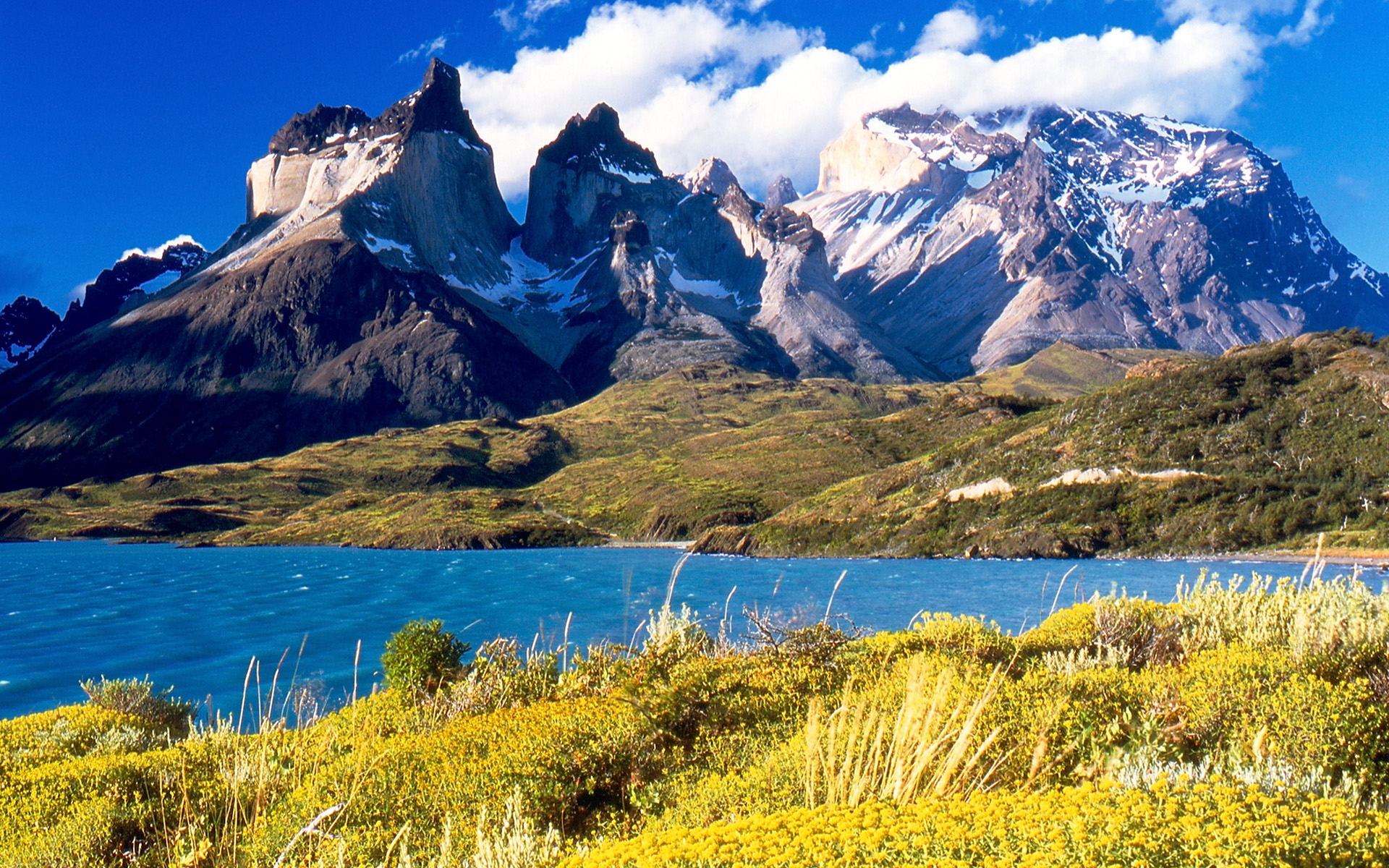
The Cuernos del Paine above Lake Pehoé
Torres del Paine · Chile · Mountains
Photo: Miguel Vieira / Wikimedia Commons, Public domainThe Cuernos rise above Lake Pehoé in a layered Patagonian landscape. Sunrise may color the peaks pink and gold, but wind and cloud set the terms.
The Shot
The Cuernos give the frame its sharp profile, while Lake Pehoé supplies color and a broad foreground. Look for a composition in which the mountain outline remains distinct from neighboring slopes. Include shoreline only when it adds a useful leading shape. A cluttered patch of stones is not automatically a stronger foreground than open water, especially when the lake's blue-green color is already carrying the picture.
At sunrise, a gap in the clouds may let pink or golden light touch the upper rock before the surrounding landscape brightens. Be ready, but do not measure the outing only by that moment. Low cloud can make the peaks mysterious, and wind can turn the lake into bands of changing texture. A clean reflection is possible in calm conditions, not a dependable feature of this exposed setting.
How to Get It
Use CONAF information to check current park requirements, alerts, and any relevant access restrictions. Confirm locally that your intended viewpoint is public and reachable under the conditions expected that morning. Accommodation grounds, roadsides, and shoreline spaces do not all have the same access rules. Avoid building a dawn plan around a map pin unless you also understand the lawful approach and safe place to stand.
Arrange transport and your return before setting out, particularly if you are not staying close to the lake. Carry layers, waterproof protection, a light for darkness, and enough supplies for a delay. Patagonia's wind can make a short exposed outing feel demanding. Pack so you can close the bag quickly, keep your hands warm, and move back to shelter without leaving equipment scattered along the shore.

Avoid the Crowds
Popular lake viewpoints can attract several photographers when the forecast looks promising. Arrive with enough time to choose a position without stepping in front of someone already composing. Work from established surfaces and accept that the safest public area may be limited. A slight shift in framing can create a different picture without requiring everyone to spread into fragile vegetation or along an unstable water edge.
If the foreground is busy, use a tighter composition of mountains and lake rather than searching for an unofficial shoreline access. Wait for brief openings only where you are not blocking movement. Sunrise visitors often concentrate on the first light, but quieter moments afterward can offer interesting cloud and water patterns. Stay only while conditions remain comfortable and your transport arrangement allows it.
Phone Photography Tips
Start with the main camera and place the mountain range high enough to give the lake a meaningful role without reducing the peaks to a thin strip. Tap a bright summit when the first light arrives and check that it retains color. A slightly darker exposure often protects that fleeting glow. Take another frame once the foreground brightens instead of trying to solve every lighting difference in one image.
Hold the phone with both hands, tuck your elbows in, and use available shelter only where it is safe and permitted. Wind can blur an otherwise sharp photograph, particularly in low light. Clean off spray and inspect a sample at full size. Avoid a long panorama if gusts make alignment difficult; a straightforward horizontal frame often describes the relationship between water and mountains more convincingly.

Shoot Responsibly
Stay on established access and durable surfaces, and avoid trampling shoreline vegetation to reach an unobstructed patch. Keep well clear of water when gusts affect your balance. Do not climb fences, use private grounds without permission, or treat a closed path as optional because sunrise is brief. Pack up early if the wind becomes hard to manage rather than waiting until moving safely is difficult.
Follow park rules for wildlife, waste, fire prevention, and any restricted equipment. Keep food and small packaging secure so nothing blows into the lake. Give animals space and never position a portrait subject close to wildlife for scale. Leave the viewpoint as you found it, with the understanding that protecting this landscape matters more than obtaining a reflection or a perfectly clear mountain outline.
Separating the Horns from the Weather
Study the Cuernos' profile before deciding how much lake to include. Their distinctive rock forms need separation from neighboring ridges and cloud to read clearly in a photograph. Where your authorized viewpoint allows it, make a medium-wide frame with the peaks as the main subject and the lake as a supporting band. Then try a broader version that describes the surrounding basin. These are different compositions, not simply different zoom settings: the first emphasizes the mountains' structure, while the second depends on the relationship between water, shoreline, and the wider Patagonian landscape.
The Cuernos are known for contrasting rock layers, with lighter granite beneath darker upper rock. When the light is soft enough, that contrast can remain visible even without a colorful sunrise. Avoid increasing contrast so aggressively that the darker portions become featureless. A telephoto view can isolate a lit summit or a break in cloud while the lower landscape remains subdued. Keep some room around the peak's outline, particularly when cloud is moving quickly. The most useful moment may be a brief separation between mountain and cloud rather than the strongest overall color.
Lake Pehoé's blue-green water can carry the image when the peaks are partly concealed. In wind, look for alternating bands of rough and smoother water, or a shoreline curve that gives those bands direction. Do not walk onto wet rocks to remove a small foreground distraction. From a secure established position, raising the camera slightly can simplify the near edge. If conditions are calm enough for reflections, check that the reflected mountain has sufficient room in the frame. A cropped reflection can look accidental unless the overall composition clearly favors the mountain above it.
Southern summer brings long days and very early light, while winter shortens the working window and can complicate access and travel. Spring and fall offer different daylight schedules but do not remove the need to prepare for sudden weather changes. Use the actual date of your visit when planning dawn, and confirm that your transport and permitted access fit that plan. Do not assume that a road or public viewpoint reachable on a mild afternoon will be equally straightforward before sunrise. Ice, poor visibility, and strong wind can change a short outing substantially.
Choose your equipment around stability and quick packing rather than maximum variety. A camera already fitted with a useful lens is easier to manage than an open bag of accessories in gusts. Keep straps under control, and never leave a tripod standing unattended while you search for another angle. If you use a tripod, position it on firm permitted ground with enough clearance for others to pass. Avoid attaching a loose bag that can swing in the wind. Increase shutter speed when necessary rather than assuming that any supported camera will produce a sharp image.
Plan one sheltered fallback composition before the best light begins. This might be a tighter mountain view from an established position or a study of water and low cloud where the summits remain absent. Having that alternative reduces the temptation to move toward an exposed shoreline when conditions worsen. Check your return arrangements, keep clothing and essentials dry, and follow current park guidance on weather and closures. A photograph that honestly records turbulent water and partial mountain visibility can describe Torres del Paine more faithfully than an imitation of a calm reflection made under unsuitable conditions.
Access rules change. Check current official information before you go: CONAF Torres del Paine


